
Single-Cell Sequencing
Multi-modal single-cell omics profiling services
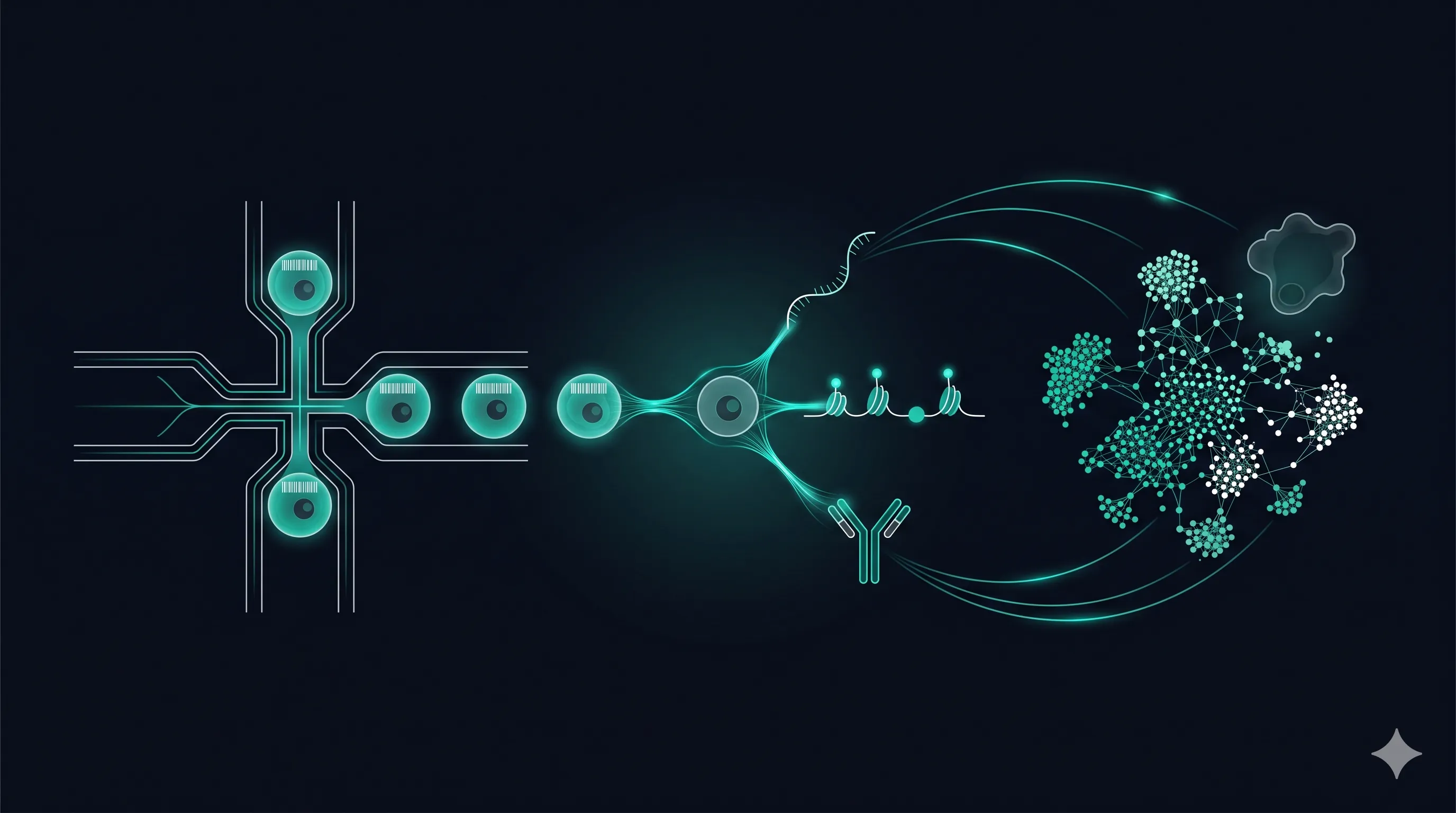
Single-Cell Sequencing Technology
The cell is the core subject of biological research — the basic functional unit of life. For a long time, traditional sequencing technologies could only provide 'average' molecular readouts across cell populations, masking individual differences between cells. The emergence of single-cell sequencing technology has advanced biological research resolution to the true single-cell level, making it possible to systematically identify cell types, reconstruct differentiation trajectories, and capture dynamic transitions of cell states within complex tissues.
Starting from transcriptomic quantification, this technology has rapidly expanded into a panoramic observation system covering genomics, epigenomics, immune repertoire, and spatial information. Researchers can obtain multi-dimensional molecular information within the same experiment, understanding gene regulatory logic, immune response lineage structure, and cell interaction networks in disease microenvironments at the cellular scale.
Based on platforms including 10x Genomics and Miroculus, we provide single-cell sequencing services covering transcriptomics, epigenomics, and immune repertoire, encompassing the complete workflow from sample preparation and library construction to data analysis.
Service Types
3' Gene Expression
Captures and sequences the 3' end of mRNA for whole-transcriptome gene expression quantification, applicable to cell clustering, cell type identification, differential expression analysis, and differentiation trajectory inference. Supports both single-cell (scRNA-seq) and single-nucleus (snRNA-seq) input modes, suitable for fresh samples and hard-to-dissociate tissue samples.
5' Gene Expression + Immune Repertoire
Simultaneously captures whole-transcriptome information and enriches full-length V(D)J sequences of T-cell receptors (TCR) and B-cell receptors (BCR) via 5' end capture, enabling concurrent analysis of gene expression profiles and immune receptor clonotypes within the same experiment. Applicable to T-cell/B-cell functional analysis in immunology research, vaccine response evaluation, and tumor immune microenvironment analysis.
ATAC-seq (Chromatin Accessibility)
Uses Tn5 transposase to preferentially insert sequencing adapters in open chromatin regions, generating genome-wide chromatin accessibility maps at single-cell resolution. Identifies regulatory elements (promoters, enhancers) and their open states across different cell types, applicable to transcriptional regulatory mechanism research and epigenetic analysis of cellular heterogeneity.
Multiome (Gene Expression + Chromatin Accessibility)
Simultaneously captures gene expression (mRNA) and chromatin accessibility (ATAC) data from the same single nucleus, enabling direct associative analysis between transcriptomic and epigenomic layers — establishing gene expression–chromatin state correspondence at single-cell resolution without the need for computational data integration or batch correction.
Surface Proteomics (Feature Barcoding)
Uses oligo-conjugated antibodies to simultaneously quantify dozens of cell surface proteins alongside single-cell transcriptome sequencing. Multi-modal data (transcriptome + proteome) enables more precise cell subpopulation delineation and functional state annotation.
Applications
- Cell Atlas & Cellular Heterogeneity Systematically identify cell types and subpopulations at the tissue or organ scale, constructing cell reference atlases under normal and disease states.
- Tumor Microenvironment Resolve functional states, clonal dynamics, and intercellular interaction networks of tumor-infiltrating immune cells, revealing the cellular basis of immune escape and therapeutic response.
- Developmental Biology & Differentiation Trajectories Track cell state transition pathways during stem cell differentiation, tissue regeneration, and organ development, identifying key transcriptional regulatory nodes.
- Immune Repertoire & Vaccine Development Analyze TCR/BCR clonal diversity and molecular features of antigen-specific immune responses, evaluating immunological effects of vaccines and immunotherapy strategies.
- Drug Mechanism of Action & Resistance Resolve transcriptional reprogramming of cell populations after drug treatment at single-cell resolution, identifying rare drug-resistant subpopulations and their molecular features.
- Neuroscience Resolve brain region-specific cell types, synaptic plasticity, and cell-selective vulnerability in neurodegenerative diseases.
Workflow
Key Capabilities
- Multi-Omics Coverage Simultaneously supports transcriptomics, epigenomics, immune repertoire, and surface proteomics at the single-cell level. Cross-omic data association from the same batch of samples reduces batch effects.
- Full-Workflow Experimental Support Equipped with standard single-cell preprocessing and quality control workflows, supporting experimental protocol optimization for diverse sample types including solid tissues, blood, frozen samples, and nuclei.
- Bioinformatics Analysis System Analysis pipeline covers all key steps of single-cell data processing — from raw data QC and alignment, to dimensionality reduction clustering, differential expression analysis, enrichment analysis, pseudotime analysis, and cell communication analysis, outputting complete analysis and visualization results.
- Customized Analysis Capability Beyond standard delivery, personalized in-depth mining based on research needs, including but not limited to gene regulatory network inference, transcription factor activity analysis, and spatial mapping inference.
Specific protocols require technical consultation to confirm.