Gene Editing Kits
Ready-to-use CRISPR gene editing kits for knockout and mutagenesis applications
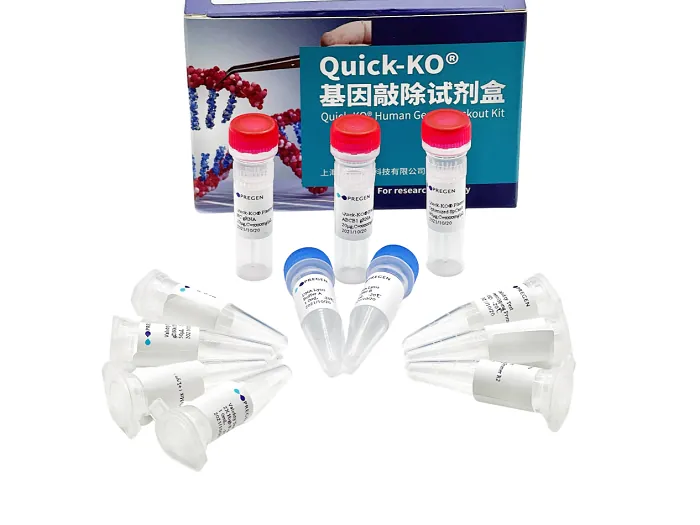
Quick KO® is a ready-to-use (all-in-one) gene editing knockout kit developed based on the Type II CRISPR-Cas system. The kit contains expression vectors for validated high-efficiency gRNAs, transfection/infection reagents, and a verification suite. Through two delivery methods — plasmid transfection or lentiviral infection — multi-guide sgRNAs are expressed in cells, directing the Cas9 nuclease to cleave the target gene, generating DNA double-strand breaks, and utilizing the cell's own non-homologous end joining (NHEJ) mechanism to achieve gene knockout.
Depending on the transfection difficulty of different cell types, either a plasmid transfection protocol or a lentiviral infection protocol can be selected, eliminating the need for separate plasmid extraction or lentivirus packaging.
Key Features
- Ready-to-use: All-in-one design, containing plasmids, PCR enzymes, and verification suite.
- Multi-guide sgRNA design: Optimized multi-guide sgRNA expression design to improve knockout efficiency.
- Selectable markers: Contains drug selection markers and fluorescent markers for flexible selection based on experimental needs.
- Streamlined workflow: No need to design and construct vectors independently.
Kit Components
- Vector expressing Cas9 nuclease
- Vector expressing sgRNA targeting the gene of interest and non-targeting sgRNA vector
- Verification suite (containing identification primers and controls)
Protocol Selection
| Protocol Type | Applicable Scenarios | Delivery Method |
|---|---|---|
| Plasmid Transfection Protocol | Easily transfectable cell lines (e.g., HEK293T, HeLa, etc.) | Lipofection or electroporation |
| Lentiviral Infection Protocol | Hard-to-transfect cells (e.g., primary cells, stem cells, suspension cells, etc.) | Lentiviral particle infection |
Applications
- Gene function research
- Drug target discovery and validation
- Cell model construction
- Synthetic lethality research
- Gene therapy preclinical target screening
Experimental Workflow
The above product description is based on standard experimental protocols. Specific experimental parameters need to be determined based on research objectives and sample conditions. Please contact our technical team for detailed experimental protocols and technical support.
Quick-KI® is a ready-to-use (all-in-one) gene site-directed mutagenesis kit developed based on the Type II CRISPR-Cas9 system and homology-directed repair (HDR) mechanism. The kit contains validated high-efficiency gRNA-Cas9 expression plasmids, Donor plasmids, and a verification suite. Through co-transfection, both are delivered into cells, where gRNA guides Cas9 protein to cleave the target gene at a specific site, generating DNA double-strand breaks (DSB), while using the mutant sequence carried by the Donor plasmid as a repair template, utilizing the cell's own HDR pathway to achieve precise point mutations at the target site.
For coding genes in human, mouse, and other species, pre-designed solutions are adopted, eliminating the need to design and construct Donor vectors independently, helping researchers efficiently complete cell gene site-directed mutagenesis experiments.
Key Features
- Ready-to-use: All-in-one design, containing gRNA-Cas9 plasmid, Donor plasmid, and verification suite.
- Precise Point Mutation: Based on HDR mechanism for single base or small fragment precise substitution, with heritable editing results.
- Dual Marker Selection: gRNA-Cas9 plasmid carries BSD resistance marker, Donor plasmid carries Puro resistance marker and mCherry fluorescent marker, supporting both drug selection and flow cytometry sorting enrichment methods.
- Streamlined Workflow: No need to design and construct Donor vectors independently, reducing pre-experiment preparation time.
- Comprehensive Validation: Includes genotyping primers and PCR Master Mix for convenient and rapid verification of editing results.
Kit Components
- gRNA-Cas9 expression plasmid (with BSD resistance marker)
- Donor plasmid (with Puro resistance marker and mCherry fluorescent marker)
- Cell Lysis Buffer (for rapid genomic DNA extraction)
- Verification suite (containing PCR Master Mix, two pairs of nested PCR identification primers, and ddH₂O)
Protocol Selection
| Protocol Type | Applicable Scenarios | Selection Method |
|---|---|---|
| Lipofection Protocol | Easily transfectable adherent cells (e.g., HEK293T, HeLa, etc.) | Drug selection (Puro/BSD) or flow sorting (mCherry) |
| Electroporation Protocol | Hard-to-transfect cells (e.g., suspension cells, primary cells, etc.) | Drug selection (Puro/BSD) or flow sorting (mCherry) |
Applications
- Gene function research (effect of point mutations on protein function)
- Disease model construction (simulating clinical mutation sites)
- Drug target validation and drug resistance mechanism research
- Pre-gene therapy mutant screening
- Protein structure and function relationship research
Experimental Workflow
The above product description is based on standard experimental protocols. Specific experimental parameters need to be determined based on research objectives and sample conditions. Please contact our technical team for detailed experimental protocols and technical support.